Showing posts with label journalism. Show all posts

Eidetic memory


Great article about the shamed plagiarist Kaavya Viswanathan (teen Harvard author) and eidetic memory, written by Joshua Foer - yes, brother of Johnathan. Clever bunch. Interesting article for Slate magazine.


No one has a photographic memory


The accused Harvard plagiarist doesn't have a photographic memory. No one does.

By Joshua Foer
Thursday, April 27, 2006

Kaavya Viswanathan has an excuse. In this morning's New York Times, the author of How Opal Mehta Got Kissed, Got Wild, and Got a Life explained how she "unintentionally and unconsciously" plagiarized upward of 29 passages from the books of another young-adult novelist, Megan McCafferty. Viswanathan said she has a photographic memory. "I never take notes."

This seems like as good an opportunity as any to clear up the greatest enduring myth about human memory. Lots of people claim to have a photographic memory, but nobody actually does. Nobody.

Well, maybe one person.

In 1970, a Harvard vision scientist named Charles Stromeyer III published a landmark paper in Nature about a Harvard student named Elizabeth, who could perform an astonishing feat. Stromeyer showed Elizabeth's right eye a pattern of 10,000 random dots, and a day later, he showed her left eye another dot pattern. She mentally fused the two images to form a random-dot stereogram and then saw a three-dimensional image floating above the surface. Elizabeth seemed to offer the first conclusive proof that photographic memory is possible. But then in a soap-opera twist, Stromeyer married her, and she was never tested again.

In 1979, a researcher named John Merritt published the results of a photographic memory test he had placed in magazines and newspapers around the country. Merritt hoped someone might come forward with abilities similar to Elizabeth's, and he figures that roughly 1 million people tried their hand at the test. Of that number, 30 wrote in with the right answer, and he visited 15 of them at their homes. However, with the scientist looking over their shoulders, not one of them could pull off Elizabeth's trick.*

There are so many unlikely circumstances surrounding the Elizabeth case—the marriage between subject and scientist, the lack of further testing, the inability to find anyone else with her abilities—that some psychologists have concluded that there's something fishy about Stromeyer's findings. He denies it. "We don't have any doubt about our data," he told me recently. Still, his one-woman study, he says, "is not strong evidence for other people having photographic memory."

That's not to say there aren't people with extraordinarily good memories—there are. They just can't take mental snapshots and recall them with perfect fidelity. Kim Peek*, the 53-year-old savant who was the basis for Dustin Hoffman's character in Rain Man, is said to have memorized every page of the 9,000-plus books he has read at 8 to 12 seconds per page (each eye reads its own page independently), though that claim has never been rigorously tested. Another savant, Stephen Wiltshire, has been called the "human camera" for his ability to create sketches of a scene after looking at it for just a few seconds. But even he doesn't have a truly photographic memory. His mind doesn't work like a Xerox. He takes liberties.

Photographic memory is often confused with another bizarre—but real—perceptual phenomenon called eidetic memory, which occurs in between 2 and 15 percent of children and very rarely in adults. An eidetic image is essentially a vivid afterimage that lingers in the mind's eye for up to a few minutes before fading away. Children with eidetic memory never have anything close to perfect recall, and they typically aren't able to visualize anything as detailed as a body of text.

In every case except Elizabeth's where someone has claimed to possess a photographic memory, there has always been another explanation. A group of Talmudic scholars known as the Shass Pollaks supposedly stored mental snapshots of all 5,422 pages of the Babylonian Talmud. According to a paper published in 1917 in the journal Psychological Review, psychologist George Stratton tested the Shass Pollaks by sticking a pin through various tractates of the Talmud. They responded by telling him exactly which words the pin passed through on every page. In fact, the Shass Pollaks probably didn't possess photographic memory so much as heroic perseverance. If the average person decided he was going to dedicate his entire life to memorizing 5,422 pages of text, he'd probably also be pretty good at it. It's an impressive feat of single-mindedness, not of memory.

Truman Capote famously claimed to have nearly absolute recall of dialogue and used his prodigious memory as an excuse never to take notes or use a tape recorder, but I suspect his memory claims were just a useful cover to invent dialogue whole cloth. Not even S, the Russian journalist and professional mnemonist who was studied for three decades by psychologist A.R. Luria, had a photographic memory. Rather, he seemed to have implicitly mastered a set of mnemonic techniques that allowed him to memorize certain kinds of information.

Viswanathan is hardly the first plagiarist to claim unconscious influence from memory's depths. George Harrison said he never intended to rip off the melody of the Chiffons' "He's So Fine" when he wrote "My Sweet Lord." He had just forgotten he'd ever heard it. And when a young Helen Keller cribbed from Margaret Canby's "The Frost Fairies" in her story "The Frost King," Canby herself said, "Under the circumstances, I do not see how any one can be so unkind as to call it a plagiarism; it is a wonderful feat of memory." Keller claimed she was forever after terrified. "I have ever since been tortured by the fear that what I write is not my own. For a long time, when I wrote a letter, even to my mother, I was seized with a sudden feeling, and I would spell the sentences over and over, to make sure that I had not read them in a book," she wrote. "It is certain that I cannot always distinguish my own thoughts from those I read, because what I read become the very substance and texture of my mind."

Psychologists label this kind of inadvertent appropriation cryptomnesia, and have captured the phenomenon in the laboratory. In one study, researchers had subjects play Boggle against a computer and then afterward try to recreate a list of the words they themselves found. Far more often then expected, the researchers found that their subjects would claim words found by the computer opponent as their own. Even if cryptomnesia is a real memory glitch that happens to all of us from time to time, however, it's hard to figure how it could lead to the involuntary swiping of 29 different passages.

Then again, who knows, maybe Viswanathan really does have a photographic memory. She could be the first (or second). Earlier this year, a group of memory researchers at the University of California-Irvine published an astonishing article about a woman called AJ who can apparently remember every day of her life since childhood. Such people weren't supposed to exist. Her case totally upends everything we thought we knew about the limits of human memory. The scientists even had to coin a new name for her disorder, hyperthymestic syndrome. If Viswanathan really wants to stick to her story, I know a few scientists who'd probably like to meet her. She might even be able to get a syndrome named after her.

Hands

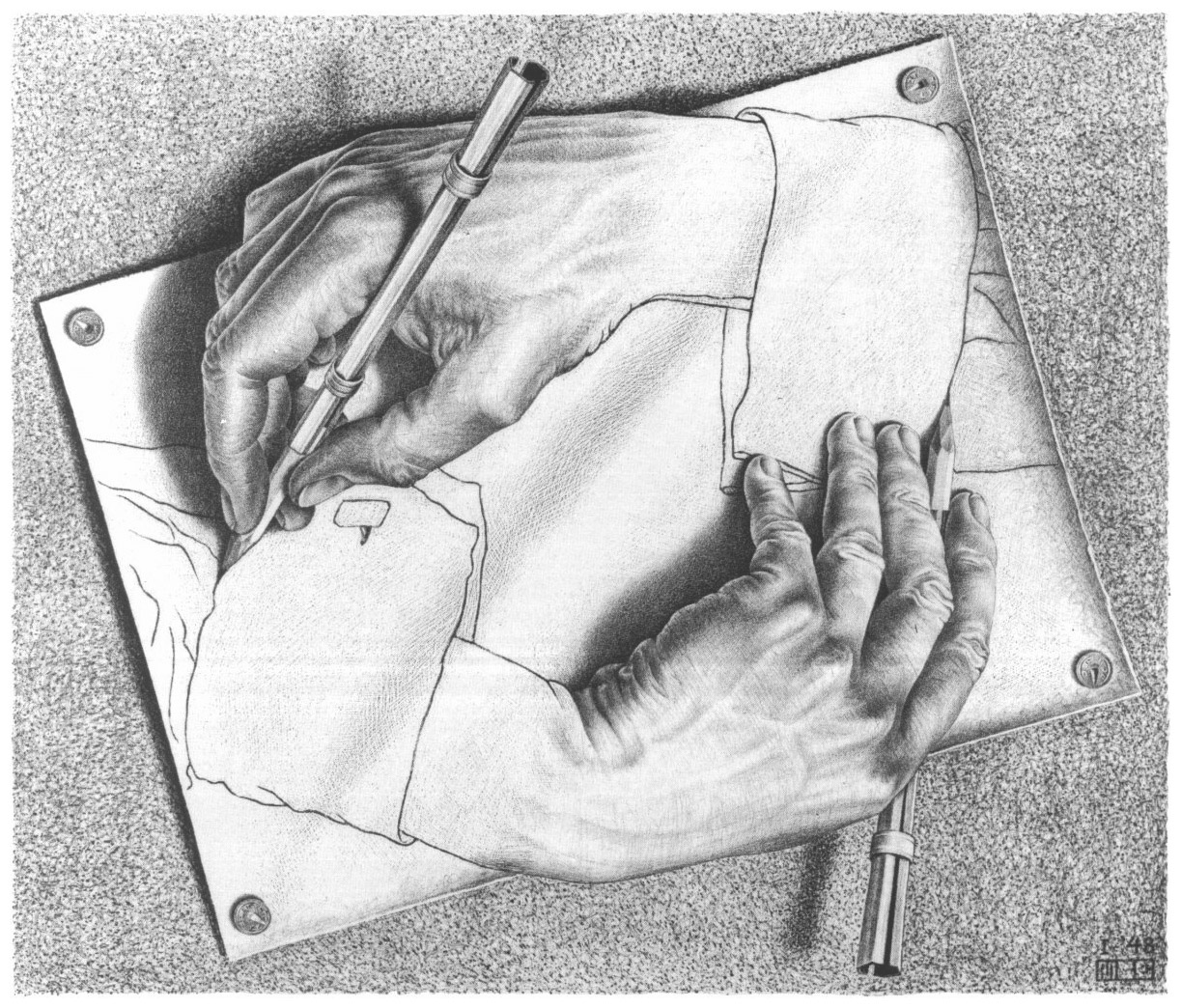
The above image is of Escher's famous and brilliant surrealist artwork, Drawing Hands. Below is an article from the BBC about hands being the windows to the soul, rather than the eyes. They're essentially defaming Will Shakespeare.

Hands, window into souls, not eyes


Fidgety, ink-stained and with nails bitten to the quick, Gordon Brown's hands (above) are fast becoming a visible symbol of the pressures he is under.

"Since he became prime minister, Gordon Brown looks cared for above the eyebrows - he has had a decent haircut". That's the pithy verdict of Veronique Henderson, co-author of Style Matters for Men.

"But nobody has told him about his hands. His stained fingers say: here is a man that does not look after himself, and who does not care about his image. And he is chewing on his nails - a sign of a nervous and worried disposition."

It's not only stylists who see significance in hands. Experts from fields as diverse as palmistry and biology say it's the hands - not the eyes - that provide the most revealing insights into a person's character.

As far as occupations go, common sense tells us that a writer or an office worker is likely to have soft hands, while the expression "horny-handed son of toil" aptly reflects the damage done by manual labour.

To the great detective, Sherlock Holmes, such a theory was elementary. "By a persons' fingernails... by the callosities of his forefinger and thumb... by each of these things an individual's calling is revealed."

It was a lesson learned well by the Khmer Rouge, which ruled Cambodia during the 1970s. In a bid to root out individual thinkers, Pol Pot's soldiers would routinely examine people's hands. Those with soft palms were deemed "intellectuals" and despatched to the Killing Fields.

Yet hands also allude to a person's age. A study by the American Society of Plastic Surgeons found that most people who were shown photographs of a female hand were able to accurately estimate the subject's age.

Giveaway

The most common giveaway, say researchers, is prominent hand veins, something that can be overcome - at least in the short term - by holding the hand up in the air so the blood drains away, says Steve Barker of the model agency Hired Hands.

"It's an old hand-model trick, and is routinely used to make a person's hands appear younger than they really are."

But while a person's hands may indicate their age or occupation, practitioners of chiromancy - or palmistry - believe the appearance of a person's hands can offer more revealing insights.

Palmist Paul Hughes Barlow, who practices beneath Brighton pier under the name Punditt Maharaj, says the shape of the hand, the lines that run across it and the way the fingers are held all indicate a specific personality; even a person's future.

"The hand is something you use to express yourself - the inside of the hand is secret and reveals a lot of what you think and feel," he says.

Hormone levels

Whilst many scientists are dismissive of palmistry, they do believe that the shape of the hand, or more specifically the relative size of the index and ring fingers, can provide accurate information about an individual.

Research by Professor John Manning, author of The Finger Book, suggests those with a long ring finger compared to their index finger are more likely to excel at sporting activities. Those with larger index fingers are more likely to be sociable.

"It is all to do with the amount of the hormones testosterone and oestrogen produced by the foetus while it is in the womb," he says. "More testosterone is indicated by a relatively large ring finger. More oestrogen shows up as a longer index finger."

Image rescue

The relative sizes of Gordon Brown's index and ring fingers are not recorded - so his testosterone levels are difficult to assess.

But Ms Henderson, who is also creative director of the style agency Colour Me Beautiful, says if the prime minister wants to work on his image, he needs to take urgent action on his hands.

"If everything was going well for him, he might get away with those fingers. But in current circumstances he needs all the help he can get."

by Julian Joyce, Thursday 15 May 2008

HIV & AIDs suck


Above is an absolutely brilliant anti-AIDs ad. The premise features the typical sex-feet type imagery, except these mid-coital feet have morgue tags attached to them. Brilliant, clever (without smugness), innovative and poignant. Great advert. I also like how these two people are in a hetero position and therefore the ad is not the typical gay AIDs ad stereotype. Just wonderful graphic design.

I have used the advert here to illustrate the below article, from the Guardian, with a HIV epidermetologist, Elizabeth Pisani, about her HIV book, The Wisdom of Whores, which I would really quite like to read and is on my list.


'People do stupid things'


When Elizabeth Pisani began her career as an HIV epidemiologist, fewer than 1.5m cases of Aids had been reported across the world. Within a year, by the end of 1997, 30 million people were estimated to be infected with HIV. As Pisani wrote in her first report for World Aids Day, that meant one in every 100 sexually active adults aged between 15 and 49 worldwide.

Today, just over a decade later, the global figure is estimated to be closer to 40 million, with more than 1.5m new infections every year. Yet there is a widespread impression that the world is now winning the fight against the virus. The perception that it threatens only sex workers, heroin addicts and gay men has been replaced by the urgent consensus that this is a universal problem - backed by mind-boggling sums.

Ten years ago, the developing world received roughly $300m a year from the west. By 2007, the figure was $10bn. This year the US alone has budgeted $5bn for HIV in developing countries - and last month the US Congress voted to commit a further $50bn over the next five years. The President's Emergency Plan For Aids Relief (Pepfar), personally initiated by George W Bush, has been described in Washington as the most successful foreign aid programme since the Marshall Plan, and "the best thing that ever happened to the poor people I work with" by one HIV programme leader in Africa. On a recent visit to the continent, Bush was feted as the saviour who has put one and a half million Africans on life-saving drugs.

"We used to sit around fantasising about having unlimited resources," Pisani recalls. "Like winning the lottery." Today, the Aids industry - "or Aids mafia", in her words - effectively has won the lottery. But Pisani is not celebrating. Her book, The Wisdom of Whores, published this week, condemns the global strategy for Aids as an ill-conceived waste of money which is not saving but costing lives.

"HIV is mostly about people doing stupid things in the pursuit of pleasure or money," declares the cover on a proof copy of the book. "We're just not allowed to say so." She suspects she will never work in the Aids industry again for saying so. "But it's true."

Pisani, 43, spent 10 years working in the field of HIV, first for Unaids and then for a non-governmental organisation (NGO) in Indonesia. As an epidemiologist, she quickly identified the risk of the virus spreading among drug injectors, gay men and the sex trade across Asia, Latin America and Eastern Europe - underdeveloped countries with inadequate resources to prevent an epidemic. That placed 100 million at risk in Asia alone - equivalent to a third of the population of the Africa. But the data was clear: "HIV wasn't going to rage through the billions in the 'general population'. And we knew it."

Like most of her colleagues, however, she also quickly realised that "governments don't like spending money on sex workers, gay men and drug addicts". So she put her skills as a former journalist to work, and began producing the sort of reports that persuaded politicians in Washington and the west that it is not "wicked people" but "innocent wives" at risk. "Aids couldn't be about sex and drugs," she explains. "So suddenly it had to be about development, and gender, and blah blah blah."

The strategy was more successful than she could ever have imagined. "All these obsessively politically correct things started getting introduced." HIV publications and conferences began devoting more time and attention to issues such as poverty, gender, development, vulnerability, leadership - what Pisani calls "sacred cows" - than to condoms and clean needles. "I'm just waiting for 'climate change and Aids'," she jokes sarcastically in her book - and sure enough, this week a headline appeared in an Australian newspaper: "Global warming set to fan HIV."

These were all far more palatable issues to politicians than sex and drugs, and the money began to roll in. But they are not, Pisani argues, what cause Aids. "We have to stop this nonsense now. Talking about 'vulnerability' will not stop people getting infected."

Pisani's relief at being free now to "tell it how it is" is palpable. After gaining a degree in classical Chinese, she joined Reuters as a reporter in the far east, and then took a masters in medical demography in London in the early 90s. She quit the field to write her book, and people are often surprised to discover she is an epidemiologist, because her charisma and sense of irony would be more familiar to a foreign correspondent's club than an NGO. "Basically," she likes to say, "my book is about sex, drugs and taxation." It is easy to see why she grew exasperated with UN colleagues who would exchange tortuous memos agonising over the most sensitive wording of something as simple as "men who have sex with men". She wasn't hostile to their liberal instincts - just impatient that semantics were wasting time, when people were dying.

There are two distinctly separate Aids epidemics, she says - one in Africa, and one in the rest of the world. In Africa, people are contracting the virus through heterosexual, non-commercial sex. But in most of the world, Pisani claims, the data clearly indicates that the risk is confined to drug users, sex workers and gay men - the very groups that Aids organisations have worked so hard to distance from the problem. Yet all the evidence of focused programmes which target these high-risk groups with effective preventative measures - condom use and clean needles - is that they work.

"We could knock this epidemic in the rest of the world on the head - just like we've knocked so many things on the head in the rest of the world - but we're not doing it, largely because of the paradigm that we're developing in Africa. The Aids industry has become an island unto itself, in a sea of common sense. That's the tragedy of it. It's unsayable."

There is more than a touch of the maverick iconoclast about Pisani. The Wisdom of Whores is full of exotic anecdotes from the colourful world of transgender prostitutes, and the language - like her manner - is lively. But the book is built around a solid body of scientific evidence, and the blend of data analysis and straight talking makes a very persuasive argument. But if Pisani is right, why isn't anyone else making it?

"If you are a data nerd, you spend your whole time looking at the numbers, and the conclusions are fairly inescapable. So a lot of the data nerds feel the same way as me. But at the NGO level, of UN organisations, we've been spouting all this stuff about development and poverty for so long that if you don't look at the data, if you just listen to the rhetoric, you'd be completely forgiven for believing that stuff."

Even if Pisani is right about the rest of the world, what can be wrong with a global strategy for Africa which has brought antiretroviral drugs (ARVs) to one and a half million of the poorest people in the world? It is easy to mock talk of "gender and development and blah blah blah", but it has persuaded a conservative president to fund HIV treatment on a previously unimaginable scale. Bush's motive may be unconventional - he is said to see global HIV as a US national security - but surely, I suggest, if he throws enough money at the wall, some of it will stick.

"Not if you're chucking it at the wrong wall."

The problem, Pisani says, is that 80% of the Pepfar budget goes on treatment. "Pepfar says great, we've got 1.8 million people in treatment. And next year it will be another 1.8 million! That will mean 3.6 million people. It's exponential - and that's the biggest question mark over the entire approach to Africa. The more treatment you have, the more infection you get."

ARVs reduce people's viral load, she agrees, making them less likely to infect someone else - as long as they don't miss a single dose. "But it also keeps them alive longer, and healthy enough to want to have sex. You only have to look at the experience of the UK or US gay communities where we've had more or less universal access to ARVs for at least eight or nine years, and the number of new infections are rising. More people are living longer with HIV, and there is what we call behavioural disinhibition: 'Fuck the condoms, I don't need them any more, because if he's positive he'll be on drugs, so he probably won't infect me. And if I do get infected, it would be annoying, but not the end of the world.'

"But having Aids is not a picnic. Yes, it's great that all this stuff on treatment is happening. But it becomes all the more urgent to have effective prevention. And that's not happening."

Even the 20 cents in every US dollar allowed to be spent on prevention is wasted, Pisani argues. A third of the prevention budget has to be allocated to faith-based organisations, which refuse to distribute condoms and will promote only abstinence before marriage. The failure rate of "virginity pledge" programmes among young Americans in the US is about 75%; condoms' failure rate is roughly 2%. Yet Pepfar, Pisani laughs, "claims its policy decisions are 'evidence based'".

Pisani's criticism of the treatment-and-abstinence approach in Africa has been echoed elsewhere. The director of America's National Institute of Allergy and Infectious Diseases told an international conference last summer, "For every person who gets life-saving drugs, six more are getting infected. Clearly, we're losing that game." Richard Holbrooke, the former US ambassador to the UN, agrees. "Focusing primarily on treatment will never succeed."

But if some in the Aids industry are willing to criticise the contradictions driven by rightwing ideology, Pisani finds them far less ready to admit the ideological motivation of their own "Poverty causes Aids" agenda. They daren't say the virus is usually transmitted by risky behaviour, she thinks, for fear of appearing "judgmental" and confirming the old rightwing attitude that
people with HIV don't deserve to be cared for.

"A good friend of mine - he works in the industry and is a sensible guy - called me up and said, 'You've got to change the blurb on the cover of your book. You can't use the word stupid. You can't call people stupid.' I said, 'I'm not calling people stupid, I'm saying they do stupid things. Not the same thing.' But he said, 'You will get absolutely crucified.' So I've had to change it to 'daft'."

She half laughs, and rolls her eyes.

"You know, it's one of the difficult things about arguing for a more targeted response. You're basically saying, 'Look, people are getting infected now because they're doing dumb things.' But people do dumb things all the time. I do. We all do. Why is it OK to be judgmental about people who smoke? But not to be judgmental about people who take crystal meth and fuck 16 guys in a weekend without condoms?"

Is Pisani judgmental?


"I don't think it's evil to have anal sex with 16 people in a weekend without condoms. I just think if you do that there's a high likelihood you're going to get infected. That's all. It's cause and effect. And I think if we can prevent a fatal disease, we should. I don't get how it's OK to keep someone alive once they're sick - but not OK to stop them getting sick. I just don't get that."

by Decca Aitkenhead, Tuesday May 13 2008


The Wisdom of Whores by Elizabeth Pisani. Published by Granta Books (8 May 2008). ISBN: 1847080006


BBC do Sex and the City


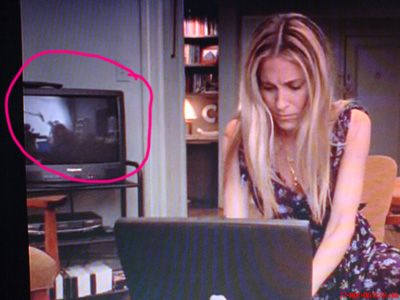
Above, a screen grab of a Sex and the City blooper - full camera and sound crew visible in the opaque TV screen. I love little oversights and geek trivia like this.


BBC News Magazine just published an article about Sex and the City and whether it deserves its place in the American sitcom canon. Short and sweet, as ever on BBC News. The comments were more interesting actually. See the original article here.


Is it just the shoes?


By Megan Lane
BBC News Magazine

Fluffy, funny and frankly outrageous to its fans, Sex and the City has long baffled a sizeable constituency of the TV-watching public - namely men. As the feature film premieres in London, what is its appeal?

It's the tantric sex workshop I remember. Sex and the City's four heroines line up on a sofa, abject fascination writ large, as a matronly type demonstrates the art of lingam massage on her naked husband.

While TV viewers don't see exactly what Dr Shapiro does to her man, his enjoyment is certainly forthcoming, especially for Miranda.

In 1999, when this episode aired on primetime TV, it was groundbreaking stuff - unbelievably frank, and funny with it. This was before sex shops populated the High Street, before celebs boasted of their sexual prowess in Heat, before furtive fumblings on Big Brother.

And before Sex and the City became better known for name-checking designers and the latest It bar.

An established brand in its own right, Sex and the City is cosmopolitan - its cocktail of choice as well as the lifestyle celebrated in the newspaper column turned best-selling book turned blockbuster television series turned A-list film.

A decade after Sarah Jessica Parker first strode about in $300 stilettos - and more than four years since the TV show ended - Sex and the City is to have its big-screen premiere in London on Monday. The original quartet reprise their roles as the thoughtful one, the smart one, the dreamy one and the man-eater. Not forgetting the fifth star, New York City itself.

Detractors deride it as little more than women obsessed with men and shoes. But this does it a disservice. Kate Smurthwaite says that as a feminist and comedienne, she is a big fan. "In fact I would go so far as to say that if you enjoy Sex and the City, you ARE a feminist.

"If you can watch the amount of sex Carrie, Charlotte and Miranda have without shouting 'harlot' at the screen; if you're not horrified by the idea of women having professional jobs, living alone, talking about sex, drinking alcohol, having children out of wedlock, experimenting with lesbianism, owning vibrators and all the other stuff they do, then you support a level of freedom for women that is a very long way off for a majority of women in today's world."

Shoe fetish

These women do go on a lot of dates and do own many expensive shoes. And they inhabit a dreamscape New York of great apartments, swanky bars, luxury hair and fabulous jobs - at magazines, art galleries, PR firms, law offices.

But where they find true happiness is in their bond, an unbroken circle of female friendship. Despite living an aspirational urban lifestyle, fans recognise something of themselves in these women.

"The characters are quite flawed and they exhibit normal traits of human behaviour - that makes them easy to relate to," says Gabriel Tate, TV editor of Time Out magazine. "There's a great chemistry between the leads which gives their relationships extra depth."

He regards the show as a finely-crafted piece of escapism.

"I live in a house full of girls and if it's repeated on TV, they will watch it - and that means so will I," says Tate, echoing a commonly-voiced experience of how many men come to the show. "It's one of those shows that stands up pretty well, although you might have thought it would date. That's down to the writing and the performances."

It made it seem sexy and normal, rather than mind-numbing, to spend hours painting your nails
Toby Young


It was smart casting to recruit established film actor Sarah Jessica Parker as the heroine/narrator Carrie Bradshaw, the alter-ego of party-girl Candace Bushnell who penned the original - and altogether darker and more cynical - columns for the New York Observer.

For it's about the lives and loves of successful single 30-somethings, and Parker was 33 at the time. The same age as her more whiny but equally funny British contemporary, Bridget Jones.

With lived-in eyes and unconventional prettiness, Parker seems more real than the cute starlets cast in producer Darren Star's earlier masterwork, Beverly Hills 90210. "It put paid to the assumption that there are no good roles for women once they hit 30," says Mr Tate.

Beauty myth

Toby Young, author of How to Lose Friends and Alienate People - also about working and partying in 1990s Manhattan - says the show resonates beyond its native New York because of its portrayal of single women.

"It encourages women to believe that they can be single and have an active social life and a great career and be as happy as Larry. But in my experience of single women in New York, it's a myth."

Bushnell herself is more Dorothy Parker than Sarah Jessica Parker, he says, and she and her friends are "like cats in a sack, constantly trying to scratch each other's eyes out".

Just as Candace is harsher than fictional Carrie, the screen incarnation bears only a passing resemblance to its source material. It picks up on Bushnell's waspish concepts, for example toxic bachelors and modelisers - men who sleep only with models - but is a gentler creation.

"Candace sold the rights to the column to Darren Star lock, stock and barrel for $50,000 and has never received a penny more," says Young, who himself knows Bushnell.

"Darren Star is a friend of hers. If that transaction was portrayed on screen, it would have enriched Carrie and her gay best friend both in equal measure."

What does ring true for him is the time and effort New York women put into grooming, from their pedicured toes to their Brazilian waxes to their blow-dried hair.

"It made it seem sexy and normal, rather than mind-numbing, to spend hours painting your nails. Its sleight of hand is to make this seem like a post-feminist choice, rather than sexual enslavement. As a man, I shouldn't really object - go right ahead, make yourselves look gorgeous for me and my leery mates."

And Tate, of Time Out London, also covets its portrayal of a job very like his own. "Endless brunches and very little work. If that's what life is like as a magazine journalist, I'm working for the wrong publication."

Perhaps it's like that in Time Out's New York office.

12th May 2008

Gordon Brown & David Cameron Travel Together

The above photograph is of David Cameron settling down on a train headed for South Wales, just at the minute Gordon Brown (far left) walks past the window with his aids, about to board the very same train. Both were on the local May election campaign trail. Photograph from the BBC. Fast thinking to get the shot.

Blood, Sweat and T-Shirts


Above is an excerpt from the BBC Three series, Blood Sweat and T-Shirts, documenting six supposed fashionistas from Britain (a few of which are about as far away from fashionistas as is possible. ie. one of them is a stereotypically bland Essex boy, oh wow fashion is a Topman bomber jacket and a scarf now is it?), one of whom look like your average trashy velour trackie bum etc etc, and one of whom can just afford to get tailored suits. Anyhow, these six are sent to a Delhi slum to work in the clothing manufacturing factories. It was an interesting episode. There is one brat called Richard though who is an obnoxious prick.

Does make you think about the clothes though. People probably think places like Primark are the worst, because their prices are so low, but in reality, they probably just mark up less and recoup profits by the sheer volume of garments they sell. The more expensive high street stores are just as exploitative, as the cost of their clothes probably does not reflect higher wages for the workers, but rather a higher mark up in the price.


The Death of the Kids' Film


Above is the original 1995 poster for Toy Story. I remember going to see the film sitting on the very back row in Edge Lane, Liverpool with family friends. It was exciting and a new visual experience. I loved it. And the Pixar short films previewing.

Below is an article written by Emily Barr for the Guardian, on how kids' films no longer cater to just those who are in single figures, but contrary to that, most of the jokes go over the children's heads and are aimed at sniggering adults. Her rallying cry is one to bring back the innocence to children's films in a world where film might be the only escape from danger and uncertainty.

Hive mentality


'What would you like to do in half term?" I asked my six-year-old recently. His eyes lit up. "Is the Ben 10 movie at the cinema?" he asked. Ben 10 is a cartoon character who is merchandised to the hilt. I cannot move in our house for tripping over one of his 10 superheroic alter egos. The Ben 10 movie, Race Against Time, was heavily trailed to Gabe's age group at the end of last year, and I was relieved to discover that it was just a TV movie.

Prince William Gets His Wings


Prince Williams gets his wings with the RAF. Source for photographs: BBC News. I love the second photograph. Willy also looks hot in his uniform.

An Interview with Kinga Burza


Justify Full

Kinga Burza interview


About half an hour outside of Central London sits the leafy suburb
of Carshalton Beeches. On this early July afternoon the peaceful
streets are disturbed only by the occasional onslaught of English
Summer Rain, which would usually only bother the patrons of the local
tea-room, all of whom toddle into the cosy interior. Today however it
also elicits mild panic in a gaggle of perfectly lacquered extras who
sit patiently out on the front lawn of one local's house while gaffers,
producers and assorted technical types eat lunch around them.

This is one reason that, in this little corner of Sutton, it isn't
difficult to find the location of Calvin Harris' latest video shoot.
Another is that it is the only house in the area with a handful of vans
and hire-busses sat on the road outside, servicing the 30 strong cast
and crew required to film "Merrymaking At My Place", a sight that will
later cause passing drivers to slow down and gawp - some offering their
services, some offering their children - all in the name of Pop Music.

At the centre of this walks Kinga Burza. It's lunch-hour, and with
a paper plate full of Thai Vegetable Curry and a smile that belies a
five am start she stops to chat with anyone and everyone on her ninth
video shoot for Partizan. In between mouthfuls of course. How did we
get here?

"To be honest it all happened by accident. The idea of making
videos was kind of a hobby until recently. I studied a Bachelor of Arts
degree in Sydney, took a Film Studies course there, but found that
short films in general intimidated me: The narrative, the
scriptwriting, the sound... But as I was really intrigued by it, and
the only way I found filmmaking accessible was to cut narrative to
music, and that's how I introduced myself to it."

Kinga is at once charming and modest. Of her childhood, in
Australia by way of Poland, she recalls "Taping the equivalent of MTV
and re-editing my own little mix tape of videos...I've always, always
had a massive appreciation for music videos." By the time University
rolled around it was that long-time love for the three-minute medium
that triggered a sense of direction. "As a twenty-something year old
girl, not really knowing why I was studying, I felt for the first time
that I got something from that Film class. After I'd made my first spec
video (to a Bonnie Prince Billy track) I started making videos for all
of my friends in bands as a kind of hobby and kind of opportunity to
self-teach myself filmmaking and editing."

What comes next isn't quite the stuff of dreams; it's a few months
after graduation before the McJob lifestyle and the sight of her
classmates going into high profile employment forces Kinga to up sticks
and head to England

"I came to London, really because I found the lack of opportunity
in Sydney to be rather exhausting and uninspiring. I had fantasised
about working at Partizan, but I was too embarrassed and ashamed to
admit that I wanted to be a director. I applied for a running position
but I didn't even get an interview. At the same time by total
coincidence - a musician friend of mine needed a video for his debut
single, so I wrote a treatment and the label chose mine. Suddenly I've
got £10,000 to make a video, and for someone who'd only ever made a
video for £50 that was a lot of money. So I went back to Partizan and
said 'I've won this pitch and I don't know what to do with it?!' and
they said '"OK, lets do this. We'll produce it for you', and once that
was job was completed, they put me on their books."

And what about Partizan was it that attracted her? "I always really
admired all of the directors there, especially Michel Gondry. I'd
always liked the naivity and the open-mindedness in his work.
Partizan's general style can be also be quite raw aesthetically;
there's some really nice creative energy that is embraced there, then
there's the animation studio... so I like that It's not all classic pop
video - of course, we have that too, and I think it's great! But I love
that individuality is enthusiastically encouraged there and this allows
for some amazing works to manifest and stand out from the rest. I guess
since working here, I've also realised that I never get the feeling
that anything is made for purely for money's sake, but genuinely for
the love of the artist, the track, idea or the experience of the
project; whatever and that's what makes Partizan such a successful
company. There is a lot of love here."

How far has this 'accident' taken her? A nomination for best
newcomer at the CADS, the highly respected industry awards, one of
MTV's most played videos with the Kate Nash track 'Foundations', not to
mention the opportunity to work with one of her long-respected acts:
"It was really exciting to work with The Thrills, because when their
first album came out they were one my favourite bands. I went to see
them live and never in my wildest dreams did I imagine that one day I'd
be directing their video, that idea never would have entered my mind"

It's perhaps not surprising though. Kinga pores over the
pre-production art, paying close attention to the aesthetics of each
video, be it costume, set design or the minutiae of lighting, creating
an exact tone for every film. She's a friendly, open presence on set,
happy to have the opportunity to work with respected industry figures.

There's obviously not the massive budget of a major artist's shoot,
but that's perhaps part of the charm of the current crop of directors
at Partizan. Newcomers like Saam, Dan Lowe and Ollie Evans are all
creating visually rich videos, establishing worlds for these songs to
exist in. For some of them the learning curve has been massive - you
can see in a body of work less than ten shoots old these directors
refining their approach, innovating to get the best out their budgets
and learning how to make the videos look as good as possible.

As Martin Poyner, one of the producers at Partizan, suggested
during the shoot, "Sometimes the budgets have to be there just to see
how far the directors can exceed expectations."

Looking at the people around me, and keeping in mind the fairly
intimate videos she's made to date, I miss-step: The crew for this
shoot is large, and I suggest it might match only her early video for
Tilly and the Wall in terms of numbers. She laughs "No, that was only
really the band, and I only had five hours to shoot!" I'm surprised,
that video looks like choreographed chaos!

"Tilly and the Wall looks really chaotic, because it WAS really
chaotic. The whole experience was crazy really - I didn't have a
professional DP on shoot, I didn't have any assistants, didn't have any
money. For today's shoot we've got, I think, five art department
assistants, and that was probably my entire crew on Tilly and the Wall.
I don't think I could ever do a job like that again though - it was too
much to handle, too much responsibility for one person. It was all fun,
but I can't even begin to imagine; if one of those gymnasts broke her
leg or something. It was a very risky one. "

It's that learning curve again. In the space of nine videos, in a
little over a year, she's gone from shoestring budgets and snatched
hours in gym halls to literally taking over one lady's suburban home.
The quality, and the challenge, for each of Partizan's directors keeps
leaping higher, something Kinga is very proud of.

"This is a professional production, with a professional crew, we've
got some of the best crew in London working on the project, we've got
one of the best best focus pullers, one of the best lighting gaffers,
I've got a really great DP, a great cast, an amazing stylist... it's a
really cool team to be working with. It's great to have this set up
supporting me so that I can focus on my role and directing
responsibilities."

Kinga's videos exist in strange spaces. Familiar seeming homes
become something more than lifelike, childhood romances seem hauntingly
universal and the world is soaked in colour treatments that make sets
appear like bleached polaroids on one hand and fantastical sweet shops
on the other. She brings to sets an eye for the perfect prop, the
well-placed splash of light, the perfect amount of clutter.

This set though becomes an exercise in restraint. 'Nana's House' is
a veritable black hole of unique paraphernalia, the collected
belongings of a life-long pack-rat. The art team have actually had to
remove boxes of belongings from the rooms of the shoot, not just in
case they're damaged but because it's too much for the camera.

In the hallway is a Grandfather Clock that the cast insist has a
sad face, while plates with floral decorations sit on the walls at odd
intervals. In one bedroom, alongside what one presumes are family
photographs, is a lone, framed poster of the Teletubbies, while in
another a cluster of lopsided handmade teddy bears sit dejectedly.

It's a beautiful, buoyant, brilliant space! It's the home that the
one in 'Foundations' grows up to become. Could an older Kate Nash live
here?

It seems, now, like the perfect partnership: Kinga, the
up-and-coming Video Director with a vibrant and colourful aesthetic.
Kate, the up-and-coming singer/songwriter, whose lyrics exist in the
hinterland behind Twee Pop Starlet and Chav poet. "About six months
ago, I saw her live and thought she was really cute, and she had this
charming yet sincere sensibility about her. At the time - because I was
a young director - I was pitching and pitching and pitching and not
winning any jobs, so I thought 'well, if I can't win anything I'm going
to go and source the work myself'."

It's quite a confident approach to take, but Kinga demurs "I think
as a music video director it's really important that you stay out there
and keep yourself in tune with what's going on in your scene. I thought
Kate had charisma and character. I loved her lyrics and thought she had
the ability to be great performer. Obviously, since the first time I
saw her she's developed and grown and blossomed into this amazing
artist, but I think I saw the potential for that to happen then."

"I think she was nervous the first time we worked together but we
managed to connect and she began to trust me. Not long after that, her
management approached me to art-direct her debut single launch, I then
art-directed a photo shoot and then we made the video for her second
single ‘Foundations’. We get along really well now, so it''d be a
really nice to do the next one!"

I ask Kinga if it's tough to work with a complete newcomer to the
medium, but she quick with an enthusiastic response "It's an amazing
feeling to work with someone who wasn't that comfortable naturally or
isn't so sure or is feeling quite intimidated by the camera and then
you make that performance work. There's something quite cool about
that, something really satisfying. I really felt that when I did the
second Kate Nash video, we had really come a long way from the first
performance."

"It's really exciting because 'Foundations' has reached to Number 1
on iTunes and Number 2 on the charts, which is pretty incredible. The
next track, I think, is going to be "Mouth Wash". It's definitely gonna
be massive...I've got a fun idea in the wings".

But what was it about Kinga's pitch that attracted Mister Calvin
Harris. "I'm always involved in choosing my videos. It was definitely
the best one, or certainly the one that looked like the most fun. It
was just a good idea, and once we had a little chat she fine tuned it
and now it's spot on."

Today's shoot revolves around 'Nana's House'. We find Calvin
house-sitting in this quiet suburban home, before a party comes
crashing in, bringing flailing debauchery, sexiness and gorgeous
costumes. Calvin narrates the narrative in a direct-to camera deadpan
while temptation and destruction swim around him.

As exciting as this sounds, the Calvin I meet is a somewhat more
subdued presence. The early start and the demands of the shooting
schedule have left him tired, but no less enthusiastic for the
experience, "It's been fun! Kinga's very nice, she's put me at ease,
and they've given me lots of fruit, which is lovely."

Stood in the dining room I ask Calvin what he thinks of 'Nana's
House'? "It's amazing! It's got all sorts of crazy memorabilia, I've
never seen anything quite like it. Definitely some... interesting
artefacts." Calvin refers to the framed clippings of the late Princess
Diana that border the room in which most of the filming is taking
place. These quirky household dressings and the assortment of chintzy
wallpaper and furniture has inspired a genuine fascination among most
the cast and crew.

Before he continues shooting I wonder if Calvin has had any trouble
adjusting to the experiences of a Pop Star? "I don't know, it's a bit
odd really. I'm still sort of finding my feet with the whole thing.
It's kind of fun, but you don't really get time to sit back and go 'Oh,
this is fun'."

On set it's tough to think beyond the next shot. As the
paper-plates are cleared away and the cables and wires start being laid
for the rest of the shoot I ask Kinga what comes next, after the end of
this 18hour day?

"There are so many young bands I like and I'd like to work with,
but - because I've been offered the opportunity - I'm aiming quite high
now! I'm looking forward to working with artists that I admire and have
admired for a really long time." The journalist in me asks for hints.
Kinga laughs. "I'm a big fan of the Yeah Yeah Yeahs, I think Karen O's
a great performer, but that's aiming very high HAHA and Calvin tell's
me Kylie Minogue is releasing a new album at the end of year, so
....you know, I could get lucky"

She's charmingly self-deprecating while mentioning those names, but
with her recent successes the fact remains that she's in with a shot.
"Sure. I've pitched on Scissor Sisters, Natalie Imbruglia, I've pitched
on Roisin Murphy and there's always that chance your treatment could
get chosen... But ultimately it doesn't matter who you're working with;
as long as you're into the track and you're into the artist and there's
that exciting attraction for you to experiment with."

"For me, one of the best pay-offs in making videos is when you
listen to a track and get that idea in your head and then you find
yourself on set with a group of people who are all there to help you
realise that idea, that is really incredible. I'm so privileged to be
able to say that I love what I do and I love the people I work with.
That is amazing".

by Matthew Sheret, August 15 2007

Art vs Science: Let's Call the Whole Thing Off!


Above, Einstein plays the violin.This article was originally published in the Education Guardian.

Why are we still having the old arts vs science debate?


Which branch of learning, in the last century, has delivered the ultimate recipe for adventure; has expanded our intellectual horizons, quickened our understanding of the world around us, and opened our eyes to the astounding possibilities of the past and the future? Piece of cake: the answer is mathematical physics.

A century ago, the Milky Way was all there was. It took a great intellect with a great telescope to take a closer look at a smudgy object called Andromeda and realise - and what a thrill that moment must have been - that Andromeda was not a star, or a nebula, at all. It was another galaxy, another entire cluster of stars, more than two million light years away.

In the course of the next few decades, Edwin Hubble and later astronomers discovered that Andromeda was only one of millions of galaxies, each containing billions of stars.

In the course of the following few decades, mathematical physicists morphed into experimental and theoretical physicists, geophysicists and astrophysicists; they started with the very small and confirmed that the universe was indeed made of atoms - the idea might be ancient, but the confirmation is hardly older than Einstein - and then they looked at the whole cosmos and realised that they didn't know the half of it: 96% of all the universe seemed to be made of some unknown stuff, and all the stars, planets, moons, asteroids, comets, continents, countries, parish councillors and coin-operated vending machines in 100 billion galaxies across 13 billion light years of space added up to a trifling 4% of all there is.

Who made this epic achievement possible, and who is now providing the instruments that illuminate the history of creation back to the first unimaginably small flicker of a second, such as the space probes that will make the journey to the distant stars and scan the void to understand why, in an apparently lifeless cosmos, the universe seems to have been fashioned so that life might be possible? The answer is another piece of cake: engineering graduates, can-do people who understand rigour and precision and stress and the limits of load-bearing structures, but whose achievements right now are opening new worlds of understanding and delight.

None of these discoveries has direct practical value. Science is part of human culture, like literature, like painting, like history. It is above everything an intellectual delight. You could call cosmology the ultimate leisure activity: it does not win bread to feed a single mouth. You could call spacecraft design a dreary, painstaking trial-and-error labour that certainly helps beam live coverage of international sporting fixtures to a billion homes (and what a preposterous fantasy that would have seemed 50 years ago), but adds nothing to the economy when it comes to sending a little planetary automaton to land on Saturn's moon Titan. You could say that and be right, but you'd also be wrong: the Cassini-Huygens mission to Titan in 2005 was an adventure as luminous as any novel, painting or science fiction movie.

I started with mathematical physics and engineering, but I could as easily have composed a hymn to physical chemistry, or biology, or palaeontology - sciences which in the same short timespan have told us the most astonishing things about ourselves, our history, our kinship with creation and our intimate relationship with the substance of the planet we share. And this hymn would have nothing to do with money-making, or idle leisure activities; it would have to do with the ultimate wealth, the only riches really worth having: the stuff in our minds.

I cannot think why we are still having the old arts v science debate, on this website and elsewhere in the media. The nine muses of the ancient Greeks stood for intellectual adventure and inquiry: an attempt to impose order and fashion meaning from the flux of events, substances, actions and reactions around us. There are lessons in history (there are always lessons in history: the trick is to work out which is the right lesson for now) and in literature, in music, in architecture, in the plastic arts.

The literary achievements of the last 3,000 years - from Homer, the Pentateuch, Ovid and Dante to Dickens, HG Wells, Marcel Proust and Thomas Mann - have provided a seam of human understanding, the riches of which are probably inexhaustible. But you could say exactly the same thing about the research of Newton, Humphry Davy, Faraday, Darwin, Einstein and the latest generation of mathematical physicists, engineers and biologists who have provided the parallel great adventure. I find the kind of arguments running right now - about what kind of student British universities ought to be producing - absolutely bizarre.

An engineer with mathematics and business skills? What use would such a person be unless he could also argue his case elegantly and persuasively in the language of Shakespeare and Dickens and JBS Haldane (science, peculiarly, is conducted almost everywhere in English)? And what would be the point of learning 17th- or 18th-century literature, or Victorian history, without also marvelling at the science that informed Newton and his Enlightenment inheritors, or Darwin and the hectic world of exploration around him?

More than 50 years ago, CP Snow, novelist, boffin and man about the corridors of power, put the "two cultures" question, as if science was somehow qualitatively different from the arts. But we cannot live without literature and art: it is through these that unique minds that lived a thousand years ago and ten thousand miles away speak directly and separately to each one of us, here and now. We cannot live without science, not because it gives us MP3 players and MMR vaccines, but because it tells us something concrete and reliable about the physical world around us. The poet shares his world with me. The scientist lights up our world for all of us. If we really only had one way of understanding the world, what kind of understanding would that be?

So we are back to the great British intellectual airport dilemma: which bit of cultural baggage should you carry into the cabin for your flight through life, and which should remain sealed in the hold? Here is the answer: it is a bogus question. There is no check-in clerk. There are no intellectual baggage limits. The destination is unknown. The flight duration is uncertain. The take-off is right now. You should take both, because you will need them on the journey, and there is no carousel at the other end.

by Tim Radford, 11 April 2008

Angelina Jolie, le humanitarian

Cycling acrobatics

Depression from a First Person Perspective


Above: a thirteen year old draws depression.

Below, an article from the Guardian, written by a playwright on her experiences of depression and life-saving group therapy.


The kindness of strangers


'Hello, I'm Zoe and I'm ... depressed." Twelve faces stare back at me, nodding sympathetically. I am in therapy for depression and I can't believe I'm here. Why am I here?

I mean, I know I suffer from depression periodically and take antidepressants, but I'm not depressed depressed. I'm just not that bad. I'm a busy woman, and to take the time to attend to some silly little person like me seems to me the height of overindulgent selfishness.

I look around the room and imagine that the other people are all here for proper depression - bipolar or unipolar or compulsive disorders that mean they can't leave the house. OK, so I get a bit down from time to time, but what's the biggie?

Well, the biggie was that my best friend decided that she had had enough of my weirdness.

"You need help," she told me, as she sat opposite me on the sofa, annoyingly entrenched.

"I'm fine."

"You are not fine," she persisted.

"OK, so I spend a lot of time alone,"

I snapped back. "I dislike the phone. I write every day. I'm driven to the point of obsession. OK, I want to be perfect - but don't we all?"

"Er, no we don't," she said, following me into the kitchen. "You walk up to eight miles a day. You take an unnaturally long time to recover from the break-up of relationships. You feel safer being alone ..."

"OK, OK, stop! I accept that I'm weird and I might need help for my weirdness but it's my fault I'm weird. It's not because I'm depressed."

"You need group therapy," she countered.

"Group what?" I shuddered at the thought.

I couldn't help feeling that sitting in a sort of "depressives anonymous" would send even the most Mary Poppins-like of us over the edge, but being an extremely nosy person, as well as a writer, I decided to go along.

A few weeks later, confronted by a roomful of expectant people, I am desperate to be anywhere else. Frankly, burning in hell seems an attractive option.

"Would you like to tell the group a little about why you are here?" asks the counsellor.

"I get a bit depressed sometimes, but it's just not that bad."

"All depression is bad," she says sympathetically. Like I deserve sympathy.

"I'm not depressed; I'm just not a very nice person. I get angry with people I don't even know - like bus drivers and people in news-agents. When anyone ever asks me how I am, I am rude because I want to cry, because how I am is bad, always bad, and they should damn well know not to ask such a stupid question, and when people call, I don't answer my phone. You see? I'm just a terrible person."

"You've just described the classic symptoms of depression," she says.

"No, no, no," I say. "You don't understand. This is what I'm like all the time."

"Well, have you ever considered that you might be depressed all the time?"

"Oh no, I've always been like this - well, since I was about eight, I suppose."

"Have you considered you might have been depressed since then?"

"No, no," I smile at her patiently. "You don't understand. I know when I'm depressed. When I'm depressed I can't leave the house. It overwhelms me like a physically sickness. It comes in waves and often I just drive around or sit in the car and cry."

"So could you possibly accept that these times you describe are serious major bouts of depression?"

I shrug and inspect my fingers, hoping that she'll move on. She doesn't.

"Do you know that a lot of people do not get out of bed for days in these bouts?"

My fingers are, at this stage, fascinating.

"The symptoms you describe are accurate for dysthymic depression - mild constant depression interrupted by occasional serious episodes."

After that first session, I take a walk. It has become stunningly obvious that my noticeable traits of character - things I had put down to personal idiosyncrasies - are actually symptoms of depression: isolation, difficulty having relationships, feeling sad, rejecting affection.

I will save you the sob story, but my parents were unhappy together and finally divorced when I was eight. My childhood losses and my feelings of rejection and abandonment could have kick-started the depression.

From both my own experience and what I have learned from psychiatrists, depression is the same feeling as grief. Grief occurs naturally after a major trauma such as an accident, bereavement or physical or emotional abuse. A person can be genetically predisposed to depression (ie, the body doesn't produce enough serotonin or some other "happy chemical"), but there is also a medical theory, to which I subscribe (promoted by Andrew Solomon in The Noonday Demon) that the brain, being a clever little sod, can learn to grieve all by itself. It says that lots of little traumas happening regularly throughout childhood and beyond (such as abandonment or the departure of a parent, or bullying or rejection) mean that the brain starts to recognise the feelings associated with grief and starts to repeat them whenever it feels like it, in the end not needing any traumatic event to stimulate it. Hence one starts to feel sadness and loss seemingly for no reason.

The knowledge that I am suffering from a depressive illness, coupled with my ability to discuss it with others in the same position, is nothing short of an epiphany. As the other people in the group talk, I find myself thinking, "My God, that's me - that's what I do" over and over again. Suddenly seeing that I am not alone in my weirdness is liberating. Perhaps I am not so terrible after all.

Then the group gives me feedback.

"I see a woman who is very hard on herself. Super-critical with impossibly high standards that she can never meet," says one man.

"I see a woman who is sad and needs to show herself a little compassion," says a lady with bipolar disorder.

Compassion? Me? Ha! That's a load of bollocks. I don't need compassion. I just need to do more, work harder - compassion is for other people.

My inner critic rages. Up to now I have relied on it to urge me forward, to keep me driven. Now I find that my negative voice is a manifestation of my illness, the lack of serotonin asserting itself, telling me I am bad and worthless.

"Are you ready to give yourself a break now?" The therapist smiles kindly. "It's been 28 years - you deserve a bit of peace."

I bite my lip and nod. Suddenly I feel like an eight-year-old again. I am made to write a letter from the adult me to the eight-year-old me, telling her that I love her.

I feel more than a little uncomfortable loving myself. I'm so used to hating myself.

You see, all those years, I thought it was normal to wake up in the morning and just see grey pointlessness. I thought it was normal to cry whenever you heard music. I thought it was normal to stare at people in the street and feel overwhelmed by sadness and futility at the sight of their pointless lives. I thought it was normal to avoid my friends most of the time. I've been seeing life in grey - like a rainy day in winter - and thinking this is what everybody sees. Happiness, whenever it has come, has been fleeting and so unfamiliar that it makes me sick with anxiety.

All of a sudden I can see that I have an illness that has gone untreated - perhaps dangerously so, because there are times I have felt so destructive or despairing that I have had no regard for my health. Now I am getting the help I need.

Of course, I am not the only person who has difficulty accepting this nebulous illness. Many people do not believe depression is real. There is no blood test that proves it, no physical handicap. Unless someone is crying in front of you how, can you tell they are depressed? They are probably just making it up, trying to get sympathy, attention, a day off work ... But let's turn this round. Why would someone want to be unable to get out of bed or go to the shops or talk on the phone or raise a smile?

I'm just thankful for the friend who loved me more than I loved myself, who stepped outside of her - and my - comfort zone and pointed it out. If you think you are depressed, you probably are - and there is no reason you should miss out on the everyday happiness that most people take for granted.

Monica Seles


An Observer article about the tragic early end to Monica Seles' career. Click below.


The day women's tennis changed forever


Those with a thing for symbolism were quick to note that the announcement came on Valentine's Day. On 14 February this year, Monica Seles issued a vanilla-bland press release asserting her retirement from professional tennis. This news, such as it was, hardly rated a blip on the radar, relegated to small print in the newspapers and ignored by most sports broadcasts. Outside of insular tennis circles, the scant mention it drew was usually along the lines of: 'Monica Seles? I didn't realise she was still playing.'

In truth, she wasn't. Once the grande dame of the WTA Tour, Seles had not scrunched her face and thwacked a ball in an official match since 2003. There had been talk of a return when her foot healed, but that never happened. Once Seles crossed the baseline into her mid-thirties, her public appearances were limited to meaningless exhibitions and pro forma sponsors' functions. It was somehow appropriate that this piddling out-with-a-whimper retirement announcement - no valedictory tour, no video montage, no farewell fanfare - consecrated the end of perhaps the most tragically unfulfilled career in sports history.

But then this, too, was fitting: a few days later, Seles made a second proclamation. She would soon be appearing on ... Dancing With the Stars, the irresistibly shlocky American version of the BBC reality show Strictly Come Dancing. A cast of celebrity contestants are partnered with professional ballroom dancers in a season-long competition. Come again? Dignified, modest Monica Seles would be dancing on television? 'Why not?' she told friends with a shrug. Why not indeed. Here we have a woman whose talents for tennis have always been rivalled by her talents for contradiction.

Once upon a time in Tito's Yugoslavia, there was a girl of Hungarian extraction, raised in relative, though not extreme, poverty. Monica Seles had a conventional childhood until it was discovered just how expertly she could swat a tennis ball against the wall of her apartment building. She could put all of her weight into her shots, yet control the ball as if she had sent it to obedience school. Though hardly a typical hyper-ambitious 'tennis dad', Karolj Seles, a cartoonist by trade, drew images of Tom and Jerry on the balls to sustain his daughter's interest. For hours, she would hit and hit and hit.

At age nine, still unsure how to keep score, Seles was winning national tournaments. By 11, she was the best junior in the world, courted by management agencies and the tennis hothouses. When the family settled on Nick Bollettieri's academy, the Seles clan moved to Florida's Gulf Coast, 5,600 miles - and an immeasurable cultural distance - from Novi Sad. Monica, then 14, had the best English skills, so it fell to her to read the contracts and negotiate the rent.

By the age of 15, Seles had turned pro and was beating Chris Evert. A year later, she won her first grand slam championship, the 1990 French Open. And from ages 16 to 19, Seles was damn near unbeatable, winning eight major titles and holding the top ranking for more than 100 weeks. (For perspective: currently, there are no teenagers ranked among the WTA Tour's top 10.) She also did what few had thought possible. She dominated - not beat; dominated - the once indomitable Steffi Graf, who was four years her senior. In a rare moment of candour, Graf once conceded that, even playing her best tennis, she was unsure she could beat Seles. This was an admission akin to Mike Tyson expressing doubts about his toughness. Had Seles sustained her trajectory into, say, her mid-twenties, she would have been recalled as the best female player ever to have gripped a racket.

Seles's game was simply revolutionary. She bludgeoned double-barrelled, two-fisted strokes, taking the ball so early she often seemed to 'short-hop' her shots - on the upward part of the bounce - in the manner of a cricket batsman. Then, as if to say it-ain't-as-easy-as-it-looks, she would punctuate her slugging with a piercing grunt - EEEEEEeeeee-uuuuuHHHHH!!! - that would become as much her hallmark as her relentless winning. (Peter Ustinov once remarked: 'I pity the neighbours on her wedding night.') Apart from the sound effects, one would be hard-pressed to call Seles a stylist. Her serve was an unseemly left-handed side-winding delivery. She treated the net as terra incognita, venturing there only when absolutely necessary. A deft touch was never her strong suit.

She won instead with a mix of insuperable power and insuperable confidence. While never particularly nasty or arrogant, she simply projected an unshakable self-belief. Time and again she sent a distinct message across the net: When it matters most, I won't miss. 'When the going got tough,' Pam Shriver says, 'Monica got you in a death grip and wouldn't let you out. That mental toughness was just unbelievable.'

Seles seemed to relish being unknowable, experimenting with fashions and hairstyles and even accents. But the enduring mystery about her was the source of her on-court ruthlessness. It was so fiercely at odds with the rest of her personality. She would administer a cold-blooded thrashing and then, five minutes later, morph into a giggly girl who spoke at hummingbird speed and prattled about fashion or her Hollywood ambitions. An American columnist likened her to 'the giddy teenager at her first wedding reception on her third glass of champagne'.

Seles almost seemed to feel guilty about competition, as it, necessarily, breeds a loser as a by-product. She told the American writer Frank Deford that her favourite moments playing tennis were exhibitions, those so-called 'hit and giggles' most players grudgingly enter only because they are paid princely fees at the end of the night. How on earth could Seles prefer these burlesques to actual tournaments? Everyone is on their best behaviour, she said. Then, at the next official tournament, Seles would kick everyone's ass from here into next week.

Even at the peak of her powers, Seles tended to engender more respect than affection. Some of this was down to her relentless winning. What sports fan doesn't reflexively root for the underdog? But beyond that, Seles was hard to pin down. Was she an assassin or an airhead? A European or an American? She wasn't gay, but neither was she overtly sexual. She lacked the cool of 'Ice Maiden' Evert, the Teutonic detachment of Graf, the outspoken activist impulses of Billie Jean King or Martina Navratilova. But if the general public struggled to grasp Seles, those who knew her well were enchanted. 'Now we shall have Seles and she will be wonderful,' the tennis courtier Teddy Tinling, the British pro who was a figure on the circuit for 60 years, once remarked. 'Completely wonderful.' He knew more than he knew.

Even the most casual sports fan can recall what happened that afternoon in Hamburg on 30 April 1993. Seles was pasting Magdalena Maleeva, victory close at hand. As she sat in her changeover chair to rest between games, an unemployed 38-year-old German, Günter Parche, slithered past two security guards, leaned over the rail and plunged a serrated knife into Seles's back. Parche would claim that he was acting to preserve the honour of Graf, a player whose losses could make him feel suicidal.

The knife, blessedly, missed Seles's vital organs. The wound would heal in a matter of weeks. The psychological scars were another matter altogether. Any 19-year-old would be freaked out at the prospect of confronting her own mortality. It was particularly so for a giddy starlet living the gilded life of a professional athlete. Suffering from what would today be diagnosed instantly as post-traumatic stress disorder, Seles awoke to nightmares and spent days shrouded in grey. Her appetite changed. Her passion for tennis wavered. She retreated into herself. Evert tells a story of chancing upon Seles in Miami airport in 1995, two years after the attack. When Seles saw Evert, she hid in the back of the plane. 'I can't pretend I didn't see you, Monica,' Evert said. Seles never came out of hiding.

Her emotional recovery was filled with setbacks. The German courts treated Parche with remarkable lenience. Noting Parche's insanity and his intent only to maim Seles - and not actually kill her! - the courts gave him a two-year suspended sentence. Der Spiegel went so far as to compare Parche to the poor man in the Second Book of Samuel, who 'had nothing except one little ewe lamb'. The magazine wrote: 'Günther Parche is even poorer than the man in the Bible.' Though hardly vindictive by nature, Seles was outraged. She could not help noticing that, while Parche walked free, she was inhabiting the equivalent of a jail cell.

For a sport too often dismissed as genteel country club divertissement, tennis can be remarkably brutal. Never was this more clear than when Seles's colleagues voted down a proposal to let her keep her number-one ranking during her absence. Gabriela Sabatini was the lone hold-out. 'Gaby is a human being,' Seles said at the time. 'The rest, they treated it like it was a sprained ankle or something.' In the middle of all this turmoil, her father Karolj was diagnosed with terminal cancer. Anything else, God? Anything else you want to throw at me?

After 27 months, Seles finally returned to tennis in August 1995, and would win another major, the 1996 Australian Open. But she was a shard of her former self. She had lost her timing and gained weight, which restricted her movement. To little avail, she hired the Olympic sprinter Jackie Joyner-Kersee and her husband Bob to help her regain her fitness. The power game she single-handedly (double-handedly?) helped inaugurate was now her nemesis. The so-called 'Big Babe Brigade' - bigger, stronger players, with Venus and Serena Williams being the most obvious exponents - emerged, and they were capable of simply outgunning Seles. Plus, she no longer giggled.

Weeks after Karolj's death in 1998, Seles, dressed all in black and with her dad's wedding ring strung on a necklace, reached the French Open final. She lost and would never again come close to winning a meaningful title. In Miami in 2000, Martina Hingis laid bare Seles's weaknesses and thrashed her 6-0 6-0. This tableau of a former champion being so thoroughly humiliated, served the dreaded 'double bagel' by a cocky upstart, ranks among the more poignantly sad scenes I have witnessed covering sport. Afterwards I asked Shriver why Hingis hadn't taken context into account and shown the mercy to give Seles a game or two. Shriver smiled. 'Think Monica would have done any different in her prime?'

It is considered bad form to bring up Parche's name in tennis circles. In the wake of Seles's retirement, the WTA's website contained a lengthy 'career obit', which conspicuously avoided any reference to the stabbing. But in the end, Parche, the deranged German, had more of an impact on tennis than any racket innovation or rule change. He skewed the dynamic of the relationship between the athletes and the ticket-buying public. Players, who once signed autographs never imagining the fan might be armed with a boning knife, grew understandably wary of the crowd.

But more than that, Parche was thoroughly successful in his goal of altering tennis history. After the incident, Graf would go on to win 11 more grand slam titles, her place in the sport's pantheon assured. Assessing Seles's career, meanwhile, was reduced to a counterfactual exercise. If she had never been savagely assaulted, might she have ...

In the crass, Wikipedia-style recitation of the facts, the Seles saga seems almost unendurably sad, an aria of misfortune. But, really, it is not sad at all. After the stabbing, something unexpected happened. Transformed from champion to tragedienne, Seles became far more popular than she was while winning all those titles. It became impossible to root against her. At first, it was strictly out of sympathy. 'A part of me wants to see Monica win,' Lindsay Davenport, one of Seles's closest friends on the circuit, once told me. 'And I'm the one who has to play her.'

Then it became something much deeper entirely. The more Seles struggled, the more fans' connection to her deepened. For all the millionaire athletes who seem to reside on another planet, Seles was gloriously mortal. She, too, grieved for a dead parent and fought a protracted battle with her waistline. She, too, struggled in her job and felt the weight of depression and woke up some mornings lamenting the state of the world. In short, she was one of us.

For throngs of fans, she became a sort of proxy for grief. I was speaking to her at a rinky-dink tournament in Oklahoma City when we were interrupted by a woman who clasped Seles's hand and explained: 'I know what you're going through because my husband Eddie has cancer.' A colleague of mine once attended a Seles match in San Diego and noticed that his seatmate was cheering mightily while holding a clear plastic bag filled with grey dust. When he could stand it no more, he asked the woman about the contents of the baggie. She explained that it was the ashes of her dead brother. He had been in a motorcycle accident that deprived him of the use of his legs and, from that moment on, became a huge Seles fan. Particularly in America, the therapeutic Oprah Nation, Seles achieved goddess status.

And, as the public embraced Seles, she hugged back. Somehow it helped her to commiserate with the woman behind her in the queue at Starbucks or share a cry with the stranger who had approached her in the supermarket. In a weird way, there was comfort in the anonymity. She could share with others the feelings she could not even discuss with her mother. 'It helps,' she told Sports Illustrated of these encounters. 'I know I'm not by myself.'

It was all so counter-intuitive. She was more popular - beloved, really - as a diminished player. And while she had every right to be paranoid and guarded after being knifed by a stranger, she was more approachable and accommodating than ever, revelling in her 'Everywoman' status. The same athlete who once took to wearing disguises and checking into exclusive hotels under an alias, started flying economy class and lounging in bookstores. Having become an American citizen shortly after the stabbing, she was summoned for jury duty in Florida a few years ago. Any self-respecting celebrity would have called her agent to get her out of it. Deeming it a patriotic responsibility, Seles dutifully served.

A few years ago, I met her at a midtown Manhattan hotel. Our conversation was supposed to be about tennis and some forgettable product she was being paid to endorse. But she spent most of the time raving about the television show Curb Your Enthusiasm. It was the sort of pleasant, frothy small talk worthy of any office cubicle. When we were through, she mentioned that she was off to go shopping. At Barneys, the posh emporium a few blocks from the hotel, I foolishly speculated? No, she replied, at Century Twenty-One, a glorified outlet store in Lower Manhattan. 'The subway goes right there,' she added cheerfully.

So it was that the star-crossed tennis champion appeared on a reality show. She was hailed as a 'celebrity' contestant but, really, this was the ultimate populist exercise. Looking remarkably happier - and remarkably fitter - than when she was playing tennis, Seles did a vague pantomine of the foxtrot against an omnium gatherum of other contestants including Elvis Presley's former wife, Priscilla, the magician Penn Jillette and the R&B singer Mario. She was 'booted off' after the initial episode, an ignominious first-round loss, one might say. But what the hell? Seles had fun. And everyone was on their best behaviour.

by L. Jon Wertheim, April 6 2008


The below article from the NY Times.


Knifed at Centre Court


Monica Seles, the world's No. 1 women's tennis player (see June 6), was attacked by an assailant on this date as she sat with her back to the grandstand during a changeover in a tournament in Germany. The following article appeared in The Times on May 2.

HAMBURG, Germany - This morning Monica Seles greeted Steffi Graf - the sad, solitary idol of her assailant. They did not know what to say to each other. "I said to her how I felt, how it also hurt me in a way," Graf recalled quietly. "We both could hardly speak. I don't want to say we were moved, we were moved, but we both were feeling what had happened very much in the moment. I told her that I was very sorry and that we are all thinking about her. She is very depressed. It came back to her more this morning than last night."

A hospital report said "the psychological condition of the patient has been attacked."

A 38-year-old German lathe operator told police he stabbed Seles, the world's No. 1 tennis player, in the back during her match Friday so that Graf, the current No. 2, could surpass her in the rankings. Identified by the police only as Gunter P., from the eastern German state of Thuringia, he said he had been planning his attack for some time before stalking Seles all week at the $375,000 Citizen Cup here.

The attacker walked to the bottom row of the grandstand, in front of where Seles sat during a changeover in her quarterfinal against Magdalena Maleeva. From behind her he turned suddenly and pulled a serrated steak knife with a 12-centimeter blade from a bag hidden under his clothing. Leaning over a short spectators' fence, he stabbed Seles once between the shoulder blades. She suffered a wound about one-half inch deep. He was apprehended by a security guard and two spectators.

"He said about his motive that he is a fan of Steffi Graf and he could not bear Monica Seles being the momentary No. 1 in the world," a police spokesman said. "He said several times that he did not plan to kill Monica Seles, he only wanted to make her unable to continue playing." Seles was expected to spend tonight at University Hospital. It was not known when she would leave the hospital or return to tennis. She is expected to miss the French Open, where she is a three-time defending champion. Most threatening to her, though, might be the psychological effect of being attacked on the court.

Monica Seles did not return to competition until August 1995. She never regained the No. 1 ranking and won only one more major tournament, the Australian Open in 1996. Her assailant, G¸nter Parche, was convicted of inflicting "grievous bodily harm," but a judge ruled him emotionally retarded and he served no time in prison.

by Ian Thomsen, April 30, 1993

Anglina Jolie Snogs Her Brother